THE QUESTION EVERY STUDENT PILOT ASKS TOO LATE
When you decide to learn to fly in Portland, Oregon, the first thing most people do is Google "flight school near me" and call the first number that comes up. They ask about price, availability, and aircraft. Almost nobody asks: "Are you Part 61 or Part 141, and what does that actually mean for my training?"
That question matters more than almost anything else you'll decide in your aviation journey — because the answer determines your schedule, your cost, your instructor continuity, and ultimately, whether you finish your certificate or become part of the 80% who quit.
This article breaks down the real difference between Part 61 and Part 141 flight training in Oregon — not the marketing version, but the honest version that experienced pilots and independent CFIs actually talk about.
WHAT PART 141 ACTUALLY MEANS
Part 141 refers to a section of the FAA regulations that governs certificated flight schools. A Part 141 school has an FAA-approved training course outline — a rigid, standardized syllabus that every student follows in the same sequence, at the same pace, with mandatory stage checks administered by the school's Chief Flight Instructor.
The theoretical advantage is efficiency: the FAA allows Part 141 students to complete their private pilot certificate in as few as 35 hours, versus 40 hours for Part 61. On paper, that sounds appealing. In practice, fewer than 5% of students complete training at the minimum hour requirement under either framework. The real-world average in the Pacific Northwest is 60–70 hours regardless of which path you choose.
What Part 141 actually delivers — in exchange for that theoretical 5-hour savings — is a rigid structure that was designed for 18-to-22-year-old career-track students attending full-time. Fixed ground school schedules. Mandatory stage checks that can't be waived. Standardized lesson sequences that don't adapt to individual learning styles. And a fleet of school-owned rental aircraft that add $163–$241 per hour on top of instruction costs at major Portland-area academies.
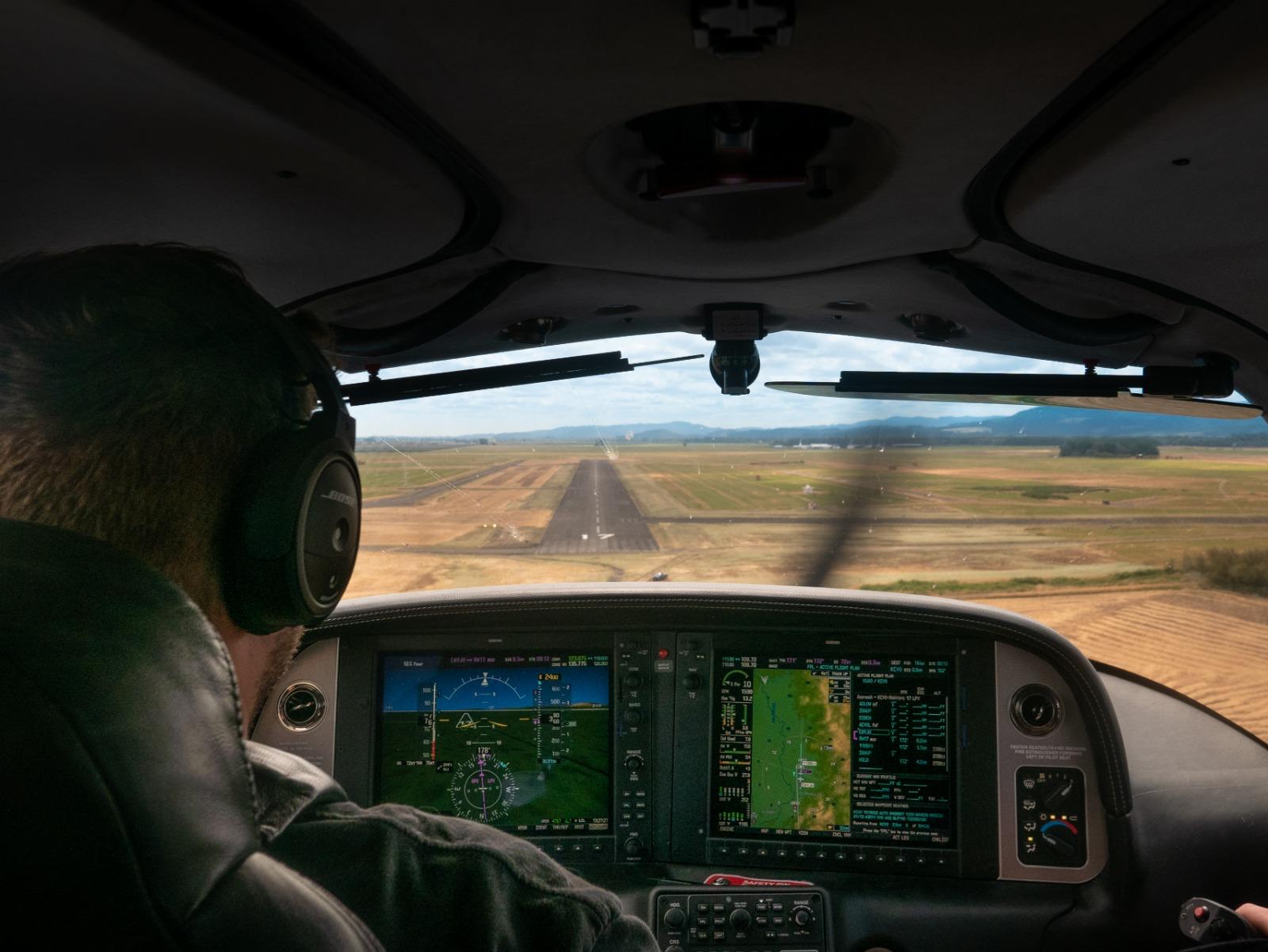
On final approach to Aurora State Airport (KUAO) — one of Dom The CFI's primary training airports in the Willamette Valley.
WHAT PART 61 ACTUALLY MEANS
Part 61 is the other section of FAA regulations — the one that governs individual certificated flight instructors operating independently, outside of a certificated school structure. A Part 61 CFI is not bound to a standardized syllabus. They design the training program around you: your schedule, your learning style, your aircraft, your goals, and your pace.
This is not a loophole or a shortcut. Part 61 training produces the same FAA certificates, the same ratings, and the same privileges as Part 141. The checkride is identical. The Airman Certification Standards are identical. The only difference is how you get there — and for most adult learners in Portland, Aurora, and Salem, the Part 61 path is dramatically more compatible with real life.
You schedule lessons when you're available — early mornings, evenings, weekends, or whenever weather and workload align. Your instructor builds the curriculum around your specific weaknesses and strengths instead of marching through a standardized checklist. And if you own your aircraft, you train in the plane you'll actually fly after you're certificated — eliminating both the rental cost and the transition training that school-aircraft students face after they earn their certificate.
THE REAL COST DIFFERENCE IN PORTLAND, OREGON
Let's run the numbers honestly, because no flight school front desk in Portland will do this for you.
At Hillsboro Aero Academy — the largest Part 141 school in the Portland metro area — instruction runs $88–$95/hr and aircraft rental runs $163–$241/hr depending on the aircraft type. For a student who completes their private pilot certificate in 65 hours (the Oregon average), that's approximately $16,380–$21,775 in instruction and aircraft costs alone — before adding $175 for the FAA written exam, $400–$600 for headsets and materials, and $400–$600 for the checkride examiner fee.
With Dom The CFI under Part 61, instruction is $60/hr. If you own your aircraft, your only variable cost is instruction time. At 65 hours, that's $3,900 in instruction — plus your own aircraft operating costs, which you'd be paying anyway as an aircraft owner. The savings compared to a Part 141 school with aircraft rental are typically $10,000–$15,000 over the course of a private pilot certificate.
Even if you don't own an aircraft, the Part 61 model with an independent CFI allows you to rent from a local flying club or FBO at market rates — often $120–$150/hr for a Cessna 172 — rather than paying the premium markup built into a school's fleet pricing.
SIDE-BY-SIDE COMPARISON
| Factor | Part 141 School | Part 61 / Dom The CFI |
|---|---|---|
| Regulatory Framework | FAA-approved syllabus, mandatory stage checks | Flexible, CFI-designed curriculum |
| Min. Flight Hours (PPL) | 35 hours (rarely achieved) | 40 hours (real-world avg: 60–70) |
| Scheduling | Fixed school calendar | Your schedule — mornings, evenings, weekends |
| Lesson Customization | Standardized for all students | Tailored to your learning style and aircraft |
| Aircraft | School-owned rental ($163–$241/hr) | Student provides own aircraft ($0 rental) |
| Instruction Rate Portland | $88–$95/hr + aircraft rental | $60/hr — no rental markup |
| CFI Continuity | High turnover — avg 18–24 months | Same instructor start to finish |
| Best For | 18–22 yr career-track students | Working adults, plane owners, recreational pilots |
WHO SHOULD CHOOSE PART 141 — AND WHO SHOULDN'T
Part 141 is genuinely the right choice for a specific type of student: someone who is 18–22 years old, attending flight training full-time, pursuing an aviation career, and has the financial backing (or student loans) to sustain $250–$350/hr combined instruction and aircraft costs without interruption. For that student, the structured pipeline of a Part 141 school provides accountability, peer cohort, and a clear career pathway.
CHOOSE PART 141 IF:
· You're 18–22 and attending full-time
· You're pursuing an airline career pipeline
· You have continuous financial backing
· You thrive in structured, standardized environments
· You don't own an aircraft
CHOOSE PART 61 IF:
· You're a working adult with a real schedule
· You own or have access to your own aircraft
· You want a personalized training approach
· You've had a bad experience at a school before
· You're in Portland, Aurora, or Salem, OR
THE BOTTOM LINE FOR PORTLAND, AURORA, AND SALEM PILOTS
If you're reading this, you're probably not a 20-year-old with unlimited time and a career pipeline to the airlines. You're more likely a working professional, a recreational pilot, a plane owner, or someone who tried a flight school once and got burned by the system. You have a job, a family, a schedule that doesn't pause for aviation — and a genuine dream to fly that you've been carrying around for years.
For you, Part 61 with an independent CFI isn't just a cheaper option. It's a fundamentally better fit. You get an instructor who knows you, a schedule that works around your life, a curriculum built for how you actually learn, and a training cost that doesn't require aircraft rental markups on top of instruction. In the Portland, Aurora, and Salem market, that means Dom The CFI at $60/hr — with your aircraft, your schedule, and one instructor from your first lesson to your checkride.
FREQUENTLY ASKED QUESTIONS
Q: What is the difference between Part 61 and Part 141 flight training in Oregon?
Part 61 training in Oregon offers fully flexible scheduling and a customized curriculum designed around each student. Part 141 schools follow an FAA-approved syllabus with mandatory stage checks, fixed timelines, and standardized lesson sequences. For working professionals and recreational pilots in Portland, Aurora, and Salem, Part 61 with an independent CFI is almost always the better fit.
Q: Is Part 141 training faster than Part 61?
Part 141 schools advertise a 35-hour minimum versus Part 61's 40-hour minimum. In practice, fewer than 5% of students complete training at the minimum. Real-world averages in Oregon are 60–70 hours under both frameworks. The flexibility of Part 61 often results in faster completion because lessons are scheduled during peak learning conditions, not around a school's fixed calendar.
Q: Can I switch from Part 141 to Part 61 mid-training?
Yes. Your logged flight hours are yours regardless of the regulatory framework under which they were earned. An independent Part 61 CFI can review your logbook and build a continuation training plan from exactly where you are. There is no penalty for switching.
Q: Which is better for working professionals — Part 61 or Part 141?
Part 61 is almost universally better for working professionals. The flexible scheduling, customized lesson plans, and ability to train in your own aircraft make it far more compatible with adult lives and careers. Part 141's rigid structure was designed for full-time students, not people with jobs, families, and unpredictable schedules.
Q: Does Dom The CFI offer Part 61 training in Portland, Aurora, and Salem?
Yes. Dom The CFI (Dominic Dixon) is an independent Part 61 CFI/CFII/MEI serving the entire Willamette Valley — Portland (KHIO, KTTD, KSPB), Aurora (KUAO, 7S3), and Salem (KSLE, 7S5). Instruction is $60/hr. Students provide their own aircraft. Flexible scheduling available 7 days a week.
Portland · Aurora · Salem, OR
READY TO TRAIN THE SMARTER WAY?
BOOK A FREE CONSULTATION.
We'll talk about your goals, review your situation, and I'll tell you exactly what Part 61 with an independent CFI will cost you — before you commit. No stage checks, no front desk, no CFI reassignment. Just one instructor and a plan built around your schedule.
Book a Free Call
Book a Free Call$60/hr instruction · No stage check fees · No front desk · Flexible scheduling